
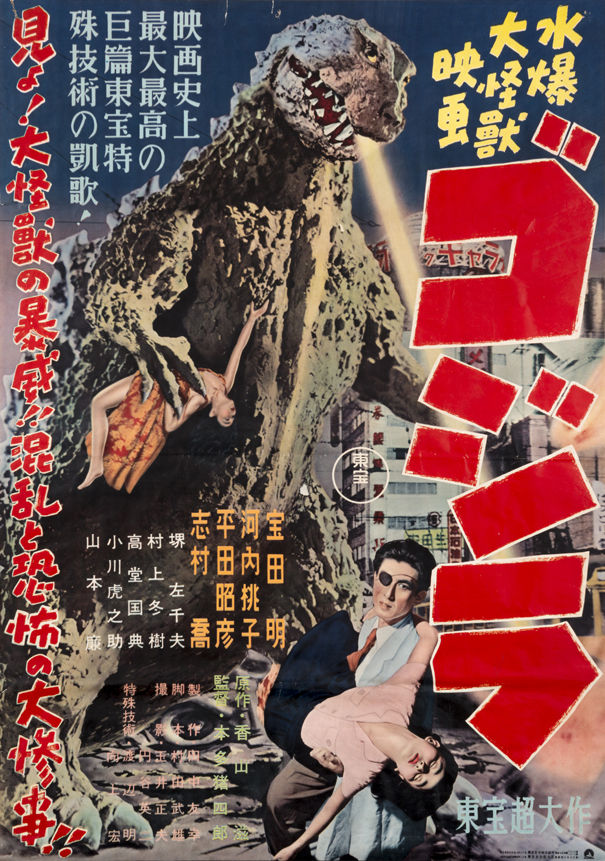
What is there even to write about, as Godzilla rapidly approaches is seventieth anniversary?
“The sea suddenly exploded.”
Why on Earth am I even writing about Godzilla? What could I possibly say about the most iconic monster this side of King Kong that hasn’t already been said before? And yet, as I sat down to rewatch this absolute icon of Japanese cinema, I realised that it would be absurd if I wrote nothing at all. And as I sat there, there was a lot I’d forgotten about this film, so marred was my memory with the dozens and dozens of features the king of monsters has been in. Yet this flagship entry in the series is a wildly different beast than the one we’d see for the following seventy years.
Godzilla shines in a few unexpected ways – or at least, in ways I hadn’t considered or had even forgotten. As one of only two films shot in black and white, it has a visual style that wouldn’t be repeated again. The moody, horror-tinged tone creates an atmosphere thick with tension, and while Godzilla does eventually stomp his way through Tokyo, his initial appearance in a sleepy fishing hamlet sells the terror of an unknown threat far more believably.
Honda uses the limitations of the black and white film hugely to his advantage. Every shot of Godzilla himself is gorgeously lit, emphasising his presence by surrounding him in epic, fiery scenes of destruction, or framed to make him as intimidating as possible with his head – almost slate black – cresting hills and buildings, bearing down upon the viewer. It’s an absolute visual delight, and his rampage through Tokyo at the one hour mark is one of the finest, most visually satisfying scenes of monster destruction in cinematic history.
The series’ political themes, while omnipresent throughout, will never be as outspoken as they are here. The spelt-out anti-nuclear message, right down to Yamane’s ominous threat of more Zillas appearing should nuclear testing continue, is most evident, but the film was also made to speak to people who had suffered through war. “You can see your father soon in heaven,” a desperate mother cries at her children. Godzilla is a bleak film at times, and it doesn’t shy away from the horrors that the creature causes. Journalists are steadfast in their reporting of the attack, fully aware of their impending death. The call backs to the war are not subtle, and they don’t want to be.
These political themes are very front and centre: something we wouldn’t really see until Shin Godzilla almost 70 years later. It’s a lot more overt than I had remembered: at one point, Emiko even mentioned what she went through in Nagasaki and Serizawa takes an almost Oppenheimer-esque role, when he fears the oxygen destroyer will be used in war. But it’s this determination to be about something that makes Godzilla so strong. Combined with never-before-seen suitmation effects that revolutionised tokusatsu films, Honda’s restraint in showing the full costume, and his determination to keep the story as serious as possible Godzilla might not be a perfect film (though it comes close), but it’s definitely a perfect Godzilla film.
Verdict: Superbly directed, the first Godzilla stands tall as the king of monsters, and king of monster movies.
Overall entertainment: 10/10
Violence: Thousands of dead civilians/10
Sex: 0/10
Iconic shots: Tonnes
Best performance: Akihiko Hirata’s troubled Serizawa is always a blast
Actual best performance: Haruo Nakajima as Godzilla, of course.
BFI DVD: Plenty of missing subs, oddly
Godzilla (1954)
Also known as: ゴジラ
Japanese
Director: Ishiro Honda
Writer: Shigeru Kayama
CAST
Akira Takarada – Hideto Ogata
Momoko Kōchi – Emiko Yamane
Akihiko Hirata – Dr. Daisuke Serizawa
Takashi Shimura – Dr. Kyohei Yamane
Fuyuki Murakami – Dr. Tanabe
Sachio Sakai – Hagiwara
Ren Yamamoto – Masaji Yamada
Toyoaki Suzuki – Shinkichi Yamada
Haruo Nakajima – Godzilla
 The Asian Cinema Critic
Leave a comment