(Trigger warning: death, potential suicide)
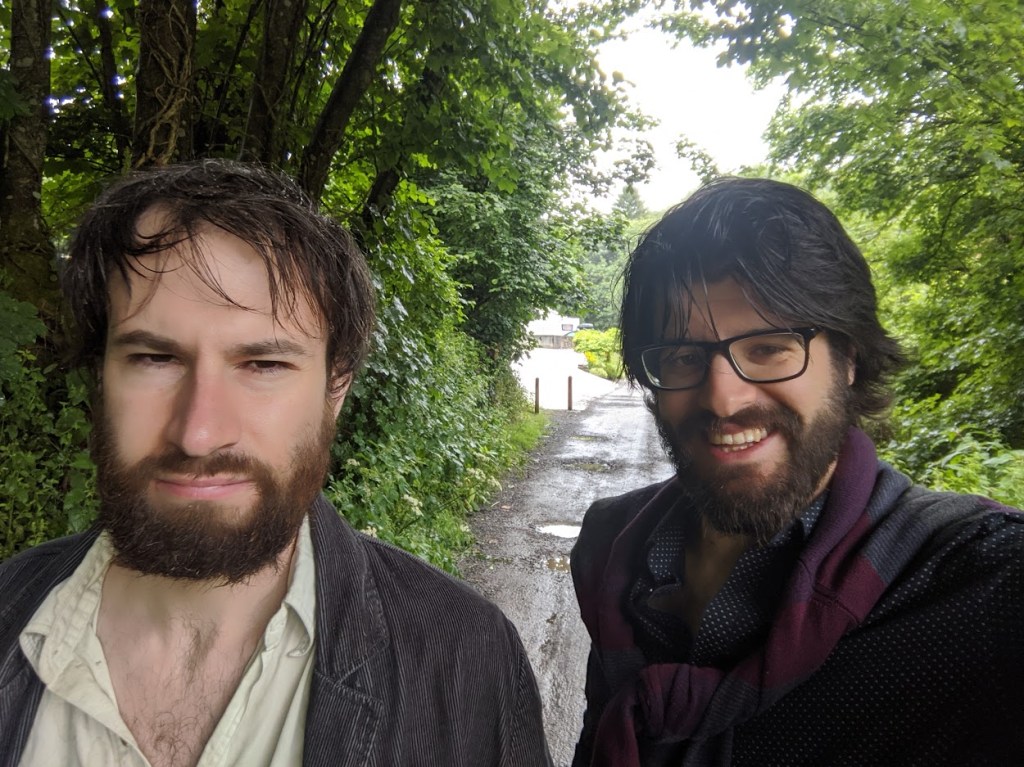
This will be something of an unusual post on the website. A few weeks ago, my former friend Harry Dalkins was found after having been missing for two weeks. He had vanished from St Ives, and was found in the waters of Doyden Castle. No foul play suspected, for what reassurance that gave. He and I hadn’t spoken in some months, and I hadn’t seen him in three years. Three years to the day, as my phone’s “on this day” feature insisted on reminding me.
I wouldn’t normally write about my deceased friend on this, a website dedicated to talking about Asian films, but Harry had a connection to the site I can’t ignore. Besides, I have nowhere else to write this, and it’s my site to do with what I please.
I’ve known the man half my life. We met at college in Cornwall, where I moved some months into the school year. We were friends because we didn’t have any. Me, a newcomer to the area and he a socially awkward guy who’d been homeschooled his whole life. He and I never quite saw eye to eye on many different topics, most of which were political in nature. He had found himself on the worst parts of the Internet immediately upon buying his own laptop, and it was impossible to keep him away.
Nevertheless, he and I shared a fascination and love for Asian culture, and our joint journey began when one of us discovered Koushin Takami’s Battle Royale. We learnt that the book – at the time unavailable in English – had been adapted a number of times, most famously as a 2000 movie starring Takeshi Kitano, as well as a 15-volume manga, illustrated by Masayuki Taguchi. He decided to read the manga, likely swayed by the graphic violence and nudity (I, admittedly, was also swayed by this), but I chose the film as it was shorter and required fewer purchases.
Battle Royale was my first true taste of Asian cinema. Previously, growing up, I’d been exposed to Crouching Tiger, Hidden Dragon and other wuxia epics were similarly also coming out – House of Flying Daggers and Hero were two massive recent hits. But Battle Royale was something entirely different. It was the first time I’d seen how different cinema from Japan – and by extension many places in East Asia – was from Hollywood.

It opened my eyes to an entire new world, one I would later explore when I moved to University and began to collect Tartan’s entire Asian Extreme collection. Harry continued to read manga, and got heavily into anime and I continued my deep, inescapable dive into the minds of Takashi Miike, Hideo Nakata, John Woo, Kim Jee-woon and Park Chan-wook. We would meet up in the summer and exchange recommendations, finding common ground in discussing those films. Those conversations would eventually lead to me wanting to write about films on the internet (after a quick failed attempt to break into video essays).
We weren’t always on good terms, Harry and I. It’s often the case with a complex relationship: no two people are identical, and even the most radically different can find common ground. After all I admired him for taking the initiative and moving to Vietnam and Cambodia for a year or two, selling art wherever he could. It was a bold step, and despite my own nomadic lifestyle, one I’d personally never taken. However, his almost hermit-like lifestyle only further distanced us, and I had, perhaps regrettably, taken to ignoring his messages for a long time in the later years.
His last two messages, both sent in January, were a voice note I never opened, and a request that I review John Woo’s Bullet in the Head. I’m not sure I can bring myself to listen to the voice note, but I owe him that review at least. He’s been asking for it for years.
 The Asian Cinema Critic
Leave a comment