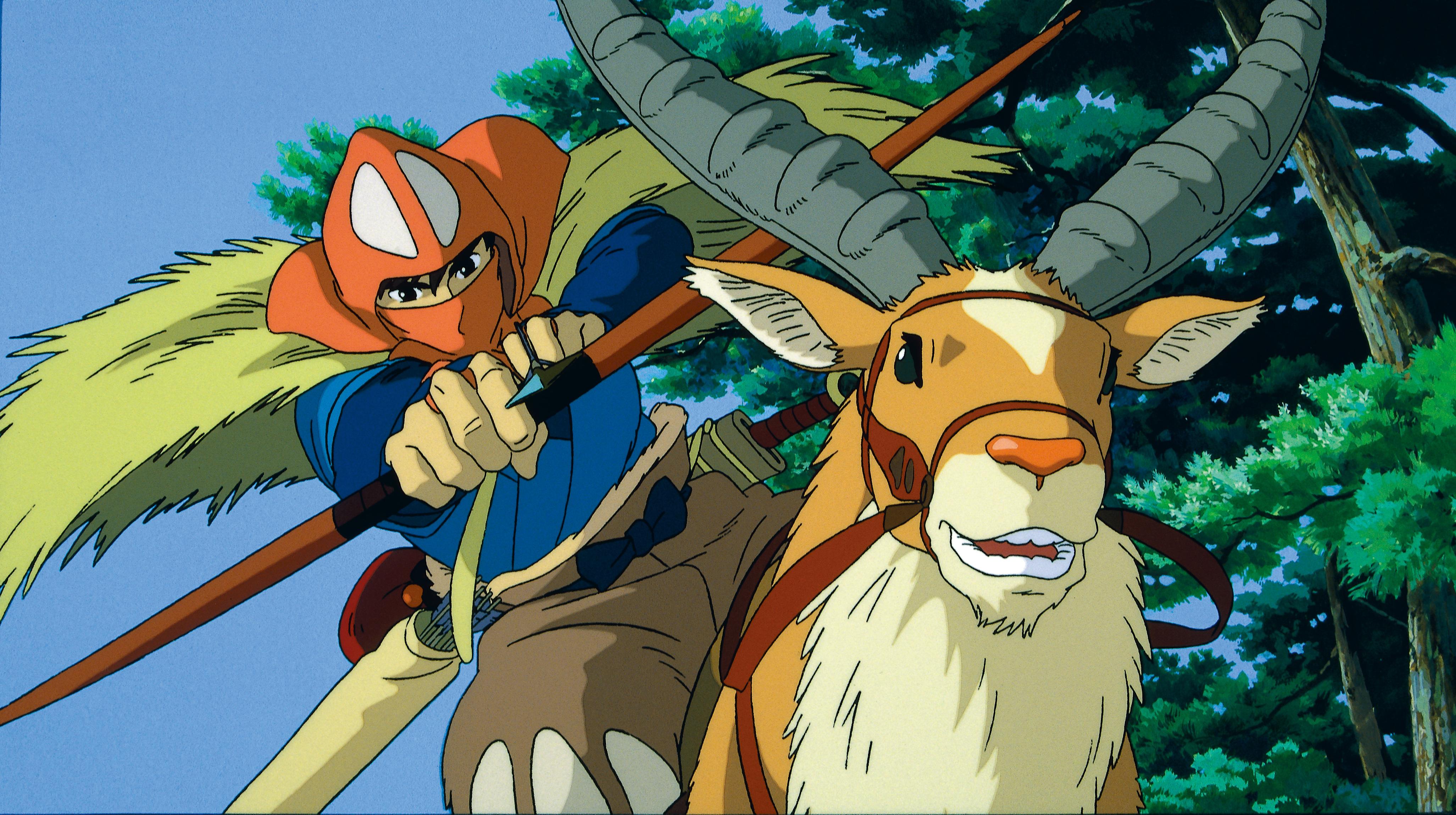

Hayao Miyazaki’s timeless tale of man versus nature feels like a classic fairy tale, with a few more decapitations.
In 1997, Studio Ghibli had a lot of movies under its belt. Having released almost one a year since 1986, it had established itself as a giant, able to compete with and sometimes even surpass Disney in their storytelling and animation prowess. However, the studio was known for generally more family-friendly films and light-hearted drama (there’s a reason Grave of the Fireflies was released on the same day as My Neighbour Totoro), and even their big adventure movie – Castle in the Sky – was a pretty goofy good time. And then came Princess Mononoke, another fantasy adventure, but one with a decidedly darker edge.
Set in Muromachi-era Japan, Ashitaka is an Emishi prince who protects his village from a rampaging boar god, turned into a demon from rage. He defeats this god, but becomes infected with the demon parasite as a result, giving his arm inhuman strength. The elders of his kingdom discover a massive iron ball in the boar, having been shot by people in the western settlement Irontown, currently in the process of razing the forest for more ore.
He decides to travel there, to not only hopefully remove the curse, but to confront the ruler of Irontown – Lady Eboshi – about the damage she is doing to the forest. Along the way he encounters the wolf goddess Moro and her adopted human daughter San, who has a passionate hate for the humans, and a mysterious deer god, with an unsettling human face and the tendency to transform into an enormous death deity at night.
Princess Mononoke is a film with more than a couple of moving parts. It introduces four (or more depending on how you view Jigo the monk) factions pretty early on – from Ashitaka, to the gods, the emperor and also Lady Ebishi. While it tells its story concisely (relatively, of course), it doesn’t delve too deeply into the real world history – whatever of there is – or the cultural context.
That’s fine, too. Ultimately it’s an adventure movie with an easy message to follow and some memorable characters and scenes. The action is fantastic, featuring some of Ghibli’s most complex work to date, as well as their goriest animation that had nothing to do with the war. The scenery is also some of the studio’s finest work: it has a subtlety in its colour palette that you don’t always see in Ghibli films. It beautifully and realistically shows the expanses of a medieval Japan. In a film concerned as it is with nature, it’s only natural that the scenery pops, and I’m impressed that they withheld from making it too saturated and fantasy-level beautiful to hit their point home.
Despite the epic way in which it tells its story, Princess Mononoke is nonetheless still pretty small. It was never tempted by a sequel, or a show or any kind of franchise whatsoever. The premise is simple enough, with enough room to grow, that Miyazaki could have easily made more, set in different locations – perhaps even times. Instead, content as ever to keep it to one, Mononoke shines as the film in their catalogue with the most potential.
Princess Mononoke remains one of Studio Ghibli’s most ambitious and mature films. It has a lot to say, and in classic Miyazaki style it isn’t subtle about it at all. There is somehow both too much and not enough story at the same time, but if you can look past that you’ll find a strong film loaded with gorgeous artistry and powerful messages.
Verdict: Excellently told, occasionally bloated, but always a treat to watch, Princess Mononoke marked a departure from the Studio’s usual style, and it paid off nicely.
Overall entertainment: 8.5/10
Violence: 5/10
Sex: 0/10
Eco messaging: 8/10
Ham-fistedness: Not as much as you’d expect
In the English dub: Clare Danes does a fantastic job, but Minni Drive and Billie Bob Thornton are absolutely phoning it in.
—
Princess Mononoke (1997)
Also known as:
Japanese
Director: Hayao Miyazaki
Writer: Hayao Miyazaki
CAST
Yoji Matsuda – Ashitaka
Yuriko Ishida – San
Yuko Tanaka – Lady Eboshi
Kaoru Kobayashi – Jigo
Masahiko Nishimura – Kohroku
Tsunehiko Kamijo – Gonza
Sumi Shimamoto – Toki
Tetsu Watanabe – Wolf
Makoto Sato – Nago
Akira Nagoya – Ushikai
Akihiro Miwa – Moro
Mitsuko Mori – Oracle
Hisaya Morishige – Okkoto
Leave a Reply