
A young woman takes on altogether too many responsibilities after losing everything, in Mari Okada’s touching fantasy drama.
“Once you love someone you’ll truly be alone.”
Before talking about the film, there’s a fair amount of world and story setup that needs to be established, this being a high-fantasy original IP. So let’s blast through it. Maquia is an Iorph (basically a reskinned Tolkien-esque elf), blessed with a centuries-long lifespan and eternal youth. They are a species somewhat isolated from the rest of the world, which has resulted in them being given the title of the Clan of the Separated. They spend their time weaving Hibiol, a cloth that chronicles the passing of time. One day, the kingdom of Mezarte attacks, seeking to find the secret of the Iorph’s longevity. They kidnap one, kill most of the others and Maquia is caught up in it all, finding herself out of the Iorph sanctum and in the human world.
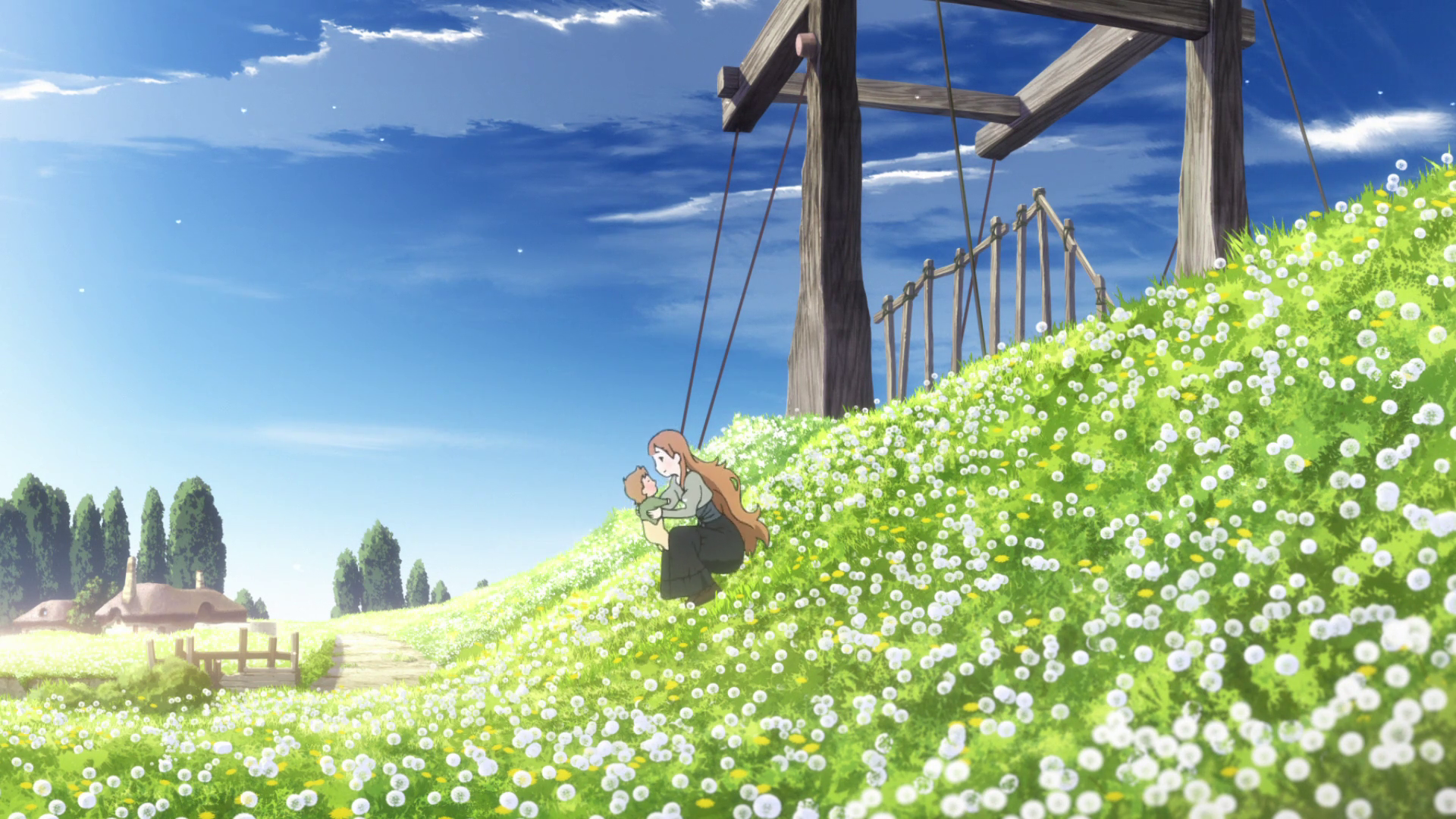
It’s at a ruined caravan that she discovers a baby, whose mother has passed away. She vows to look after it, but being a child herself has no idea how. She names it Ariel, and comes to live with the baby at a farm, where she helps out in town to make a living. She learns that Lellia, the kidnapped Iorph is forcefully married to the prince, and sets out with her adopted son to rescue her. There, she meets Krim, a fellow Iorph also set on rescuing her. From there, the story carries on, showing snippets of their lives every seven or so years, documenting the Kingdom’s rise in power, and the development of Maquia and Ariel’s relationship.

There’s a lot to set up here, but it’s all in service of what ultimately boils down to a very straightforward narrative: a group of people want to exploit another group of people, usually under the pretence of the Greater Good. But all of that is just in service to what the real story of Maquia; which is of a tale of how strong the bonds of motherhood are, and how deep the ties that bind can be. The real story here is of the shifting sands that comprises Maquia and Ariel’s relationship. It’s heartwarming and heartbreaking, and as complex as you’d imagine. Ariel’s changing affections are a pain that every mother no doubt feels, and in Maquia it’s doubled thanks to her different physiology, culture and background. There’s a deep, profound heartache to knowing you’ll outlive your child.

I’ve blasted past a lot of the fantasy and political elements because they’re neither that exciting nor are they particularly novel. They’re just background that help shift the real story along, and provide difficulties and obstacles for the main characters to overcome. Maquia, When the Promised Flower Blooms could have been set anywhere and have been able to keep its powerful, core messaging alive. That said, her being an Iorph and her adopted son’s increasing distancing of her thanks to their narrowing visual age gap is something that could have only happened here
This is largely thanks to its good characters. Maquia takes a bit of time to become a fleshed out character, but by the end has matured so much that her ultimate decisions have real weight. The same is true for Ariel, whose entire life we get to see (more or less), and so gets by far the most character development. It might be a fantasy set in a world where elves are master weavers, but the humanity behind Ariel, Lang, and even Maqiua is what drives the story and what makes it such a compelling watch.

Without a compelling mother and child dynamic, the story goes nowhere so it’s a good thing that Maquia has those. This allows it to explore what it means to be a mother: the sacrifices and choices one must make, picking the betterment of your child over yourself. Maquia shows us this in multiple ways: primarily through the actions of its title character, who has no blood relation to her son, but who nonetheless feels that drive to do anything to protect him. It’s worth pointing out that Ariel says this to his mother, but like most children can’t keep that promise when it’s time for him to move out on his own. The other character who does what she must for the sake of her child is Leilia, whose pregnancy was definitely non-consensual, but who will nonetheless do what she must to ensure it has the best possible chance at life.

If only the film was as focused as this. The biggest issue is that it has a lot to say and ends up getting its messages a bit muddled in some key areas. Notably, the kingdom ransacking ancient civilisations and cultures in order to grow feels an excellent take on colonialism and parasitic globalisation that could carry an entire film, but sometimes takes away. You could argue that the film is putting the kingdom in a reverse position: taking from the people it’s meant to look after, but that isn’t true. The villagers all seem pretty content with what their motherland is doing.
But minor gripe aside, Maquia, When the Promised Flower Blooms delivers powerfully on what it wants to say, blending in likeable characters and relatable moments into a heart-wrenching fantasy drama that’ll make you want to call home.
Verdict: Tearjerking without being overly saccharine, this is Mari Okada’s strongest film yet.

Overall entertainment: 8/10
Violence: 4/10
Sex: Only some implied rape/10
Tears: 5/10
Flowers: None. I was promised a bloom!
Fantasy terms: Guys, just call them dragons
Coincidences: Meet everyone you’ve ever met, but only once every seven years

Maquia, When the Promised Flower Blooms (2019)
Also known as: さよならの朝に約束の花をかざろう (Let’s Decorate the Promised Flower on the Morning of Goodbye)
Japanese
Director: Mari Okada
Writer: Mari Okada
CAST
Manaka Iwami – Maquia
Miyu Irino – Ariel
Ai Kayano – Leilia
Yuki Kaji – Krim
Yoshimasa Hosoya – Lang
Miyuki Sawashiro – Racine
Rina Sato – Mido
Yoko Hikasa – Dita
Misaki Kuno – Medmel
Leave a Reply