By Emily Jisoo Bowles
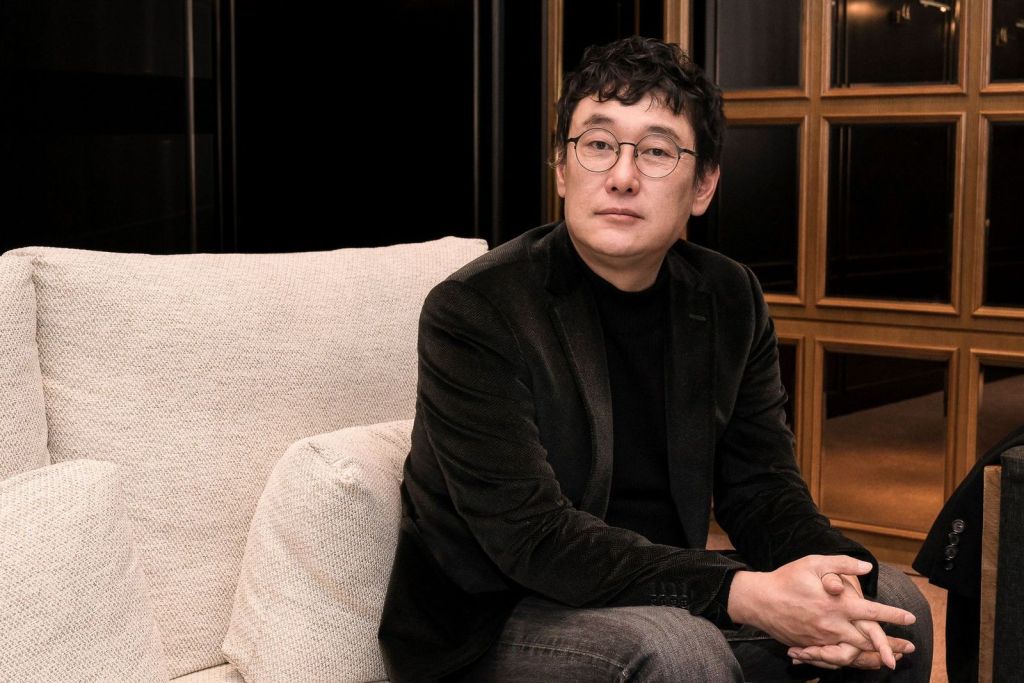
21 years after its release, Save the Green Planet is back on the big screen as part of the BFI’s Echoes in Time Korean season, showcasing films from both the country’s golden era of the 60s and the new Korean cinema of the late 90s and early 00s. I meet director Jang Joon-hwan at the BFI Southbank before the screening of his explosive film to ask him how he feels about it now, if he believes in conspiracy theories, and what he thinks about the American remake. I conduct the interview in Korean, which helps build a rapport and I’m pleasantly surprised when he gifts me a 때수건 (Korean exfoliating towel) at the end. Thank you for protecting me from alien telepathy, director Jang. I can also finally scrub my own dead skin off my feet.

I rewatched the film last night and I found that I still really like it. Its tone is largely pessimistic about the world, sometimes ridiculous, other times deeply poignant and sincere. Has your view of the film changed at all since 2003?
This film is a tragicomedy. As Charlie Chaplin once said, “Life is a tragedy when seen in close-up, but a comedy in long-shot.” So, what distance do we maintain when we’re looking at our society or planet earth? How does the world look different from the perspective of other living beings out there? That was the starting point of the film. 20 years after making it, I feel very lucky and grateful for the opportunity to be able to still meet audiences. However, at the same time, I think it’s quite sad and unfortunate that even though much time has passed, we still live through events similar to what happens in the film.
I loved seeing the earth from the aliens’ perspective, as you said that distance is very illuminating. I’m curious what drew you to conspiracy theories. Do you believe in any yourself?
I think as a filmmaker I had a sense of responsibility to not believe in any conspiracy theories. However, I am interested in people who go slightly crazy whilst living in our society. In my short film 2001 Imagine, the protagonist believes that he’s a reincarnation of John Lennon. He’s facing a lot of hardships and he goes slightly mental in order to get through them. Through these people who go a bit mad, I believe we can hold up a mirror to society and make films where our problems can be reflected through these characters.
I was really shocked but also deeply moved by the ending. Have your feelings towards it changed with time?
From the very conception of the film, I knew that this was the ending I wanted to work towards. When reflecting on living on this earth and in Korean society, I decided to explore these ambivalent dual emotions we hold of both love and hatred towards other human beings. The shocking ending almost acts as a cure to these feelings. You’re asking if my feelings towards the ending have changed since making the film and I mentioned before that the world has changed somewhat: in some ways it’s good that it’s become more developed. But in other ways, it seems like not much has changed, or some aspects have even deteriorated, and we keep repeating the same tragedies which I think is very unfortunate.

On the topic of Korean society, have you found there to be a big difference in the way Korean audiences vs foreign audiences regard the film?
Since the release of this film in 2003, I’ve been invited to many international film festivals and met many foreign audiences. This might be an odd thing to say, and of course some of their responses were very different, but what I found was that many voiced similar feelings to Korean audiences. It’s a very Korean story, containing what I saw and experienced growing up, such as the tragedies and the violence I encountered, which I thought was very Korean. However, foreign audiences with their very different histories nonetheless felt very similarly to me about the film. It was oddly surprising, but I was also very pleased to hear this.
I heard there’s going to be an American remake of Save the Green Planet. How do you feel about that?
Initially I was going to direct the remake, but unfortunately I had some health problems which meant I couldn’t continue working on it. That’s when director Yorgos Lanthimos joined the project, he has a very unique directing style and vision. I’m very curious and excited to see how he will remake this film. Currently, I remain as the executive producer and they’ve cast some great actors so I can’t wait to see how they will play those roles.

I’m curious about you casting Shin Ha-kyun. I watched your short film Hair where he also plays a character who is single-mindedly obsessed with achieving a goal and he’s amazing. What’s it like working with him?
When I was first casting, I had a very strong conviction and preference to work with Shin Ha-kyun. I remember waiting for him for a long time to go shoot a whole other film before he came back to star in mine. I had seen this magazine article with four photos of his face side by side and the feelings that he evoked in each photo were completely different and I think that’s why I thought that he would be perfect to play the character of Byung-goo. On one hand Byung-goo can be very strong and violent but on the other hand he’s also quite gentle and vulnerable. He has as much capacity for love as he does for hatred, he’s a very complex character that I thought Shin Ha-kyun could pull off. When we started filming, I remember thinking the wait was completely worthwhile. He has this great energy which he used to portray all the complexities of the character really well.
On that note, I think Korean cinema is very adept at portraying mentally ill people who have been worn down by society in an empathetic light, like the John Lennon reincarnation from your short film. Would you agree with this, and do you have any favourite examples from Korean cinema?
As you say, Korean characters are usually very complex and have strong personalities. Right now I’m slightly jetlagged so I just can’t think of any immediately off the top of my head, my apologies.
No worries, I can ask a broader question about Korean cinema. 2003 was a great year for it. Do you still feel excited about Korean films coming out now?
I continue to have hopes for Korean cinema, but since 2003 the industry has become more commercialised and grown in scale, with bigger budgets and much more bureaucracy involved in the filmmaking process. Films that were made back in 2003 like Save the Green Planet, A Good Lawyer’s Wife, Oasis etc. are not purely commercial films, they have many provocative and experimental elements. I think nowadays it’s much harder to make films like these and personally I would like to see more challenging or boundary pushing stories. It’s a shame that it’s becoming harder to do so.
Are you going to continue making these kinds of challenging films in the future?
I would like to, as much as possible. However, in order to make films I also have to work within the system. I think this might be why I have such long intervals in between making films, if I can make some kind of excuse for myself.

The 19th edition of the London Korean Film Festival (LKFF) is organised by the Korean Cultural Centre UK (KCCUK) and supported by the Korean Film Council as part of the ‘Connect Korea Campaign’, which promotes Korean arts and culture across the UK.
 The Asian Cinema Critic
Leave a comment