
Mongolia’s mining practices prove as layered as the mines themselves, in Khoroldorj Choijoovanchig’s quiet documentary.
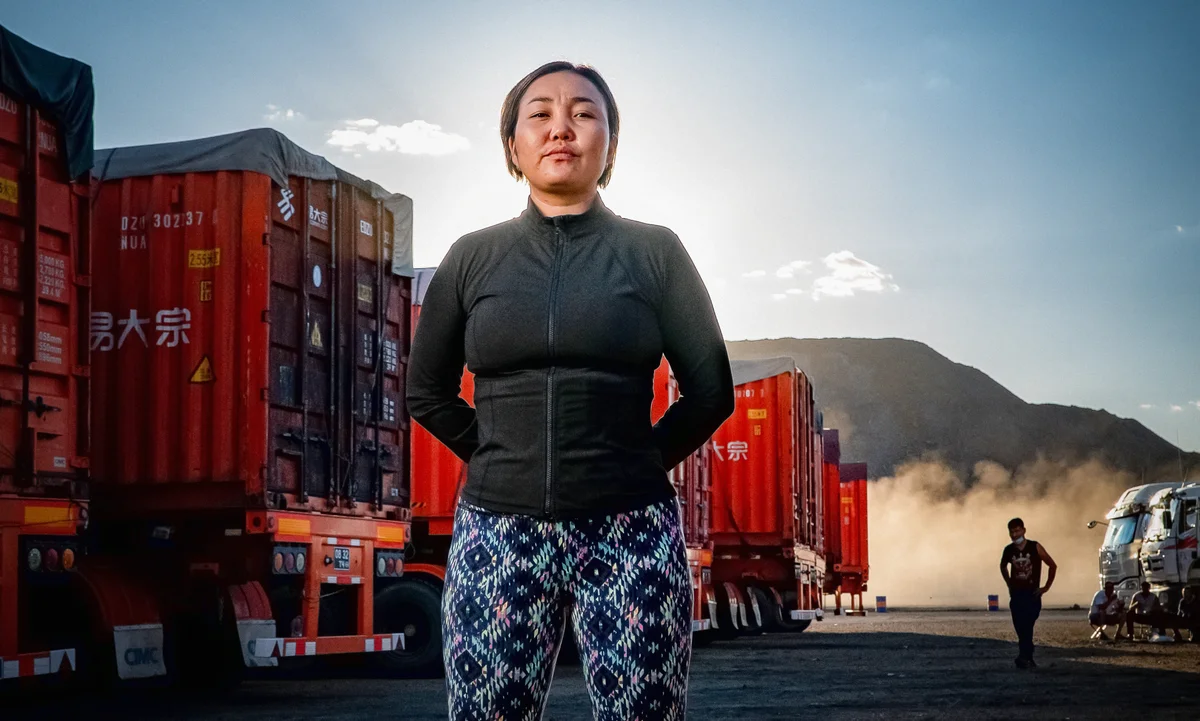
Maikhuu is one of many truck drivers delivering Mongolian coal to China, making the extremely long journey dozens of times over several months. In that time, she doesn’t get to see her children grow, but she remains with the work to offer them a good life. With hundreds of other truck drivers all trying to reach their destination at the same time, conditions are uncomfortable, cramped, and dangerous.
Colours of the White Rock is a film with a few things to say, told through the point of view of a woman who has travelled its trail many times. The mines themselves, she points out, are important for the economy, keeping a thousand people employed at any one time. From the miners themselves, to the drivers, the food merchants and mechanics, there are so many who eke out a living thanks to the mines and the road that leads to them, but the impact of the industry on the natural beauty and the stability of the country is at stake.
The film doesn’t necessarily disparage the mines, or the industry surrounding it. From the beginning, Maikhuu discusses their benefits; but no benefits come without a cost, and this is where Khoroldorj Choijoovanchig’s film shines. It acknowledges the damages made by the industry to Mongolia: the scars that run across the land as the earth is gutted to benefit another nation entirely. Mongolia is in a difficult position: it has a chance to make a name for itself through a powerful nation, but it risks being exploited fully in the process.
Maikhuu makes for a great protagonist to showcase this. Her position as one of the only female truck drivers puts her in a weak position against her stronger, more numerous and stronger male counterparts. Balancing her roles as a caregiver, breadwinner and worker for the Mongolian people, Maikhuu is stretched thin, her own mental and physical resources being drained as quickly as the land from which she hails.

A lot of the story is us experiencing one of these trips, and the way it can grind people down: the waiting in the middle of nowhere, the unbelievably long queues, the people – not all of whom are friendly – and the slow, choking miasma that is sitting behind hundreds of trucks emitting diesel fumes. Maikhuu is a small piece of the puzzle, and the film doesn’t hesitate in showing us this through shots of her jumping to get into her truck, being dwarfed by the very machine she commands. When she quits in order to make more time with her children, she is back in a world where everything seems to fit her better, but the jobs she has aren’t enough, and the pull of the road gets her back on the long trek to China before long.
There is a saying in Mongolia, we’re told (albeit not a very old saying, it must be accepted): Coal truck drivers can never really leave the road. It’s both a calling and a tether; a chain from which she’ll not escape, in the shadow of a country that cares only about draining the resources from her and everyone who works in White Rock. “Other countries are developing, why can’t we?” muses a driver, mournfully. I suppose it’s difficult when the very soil is being ripped from beneath your feet, to be consumed by an all-powerful, uncaring giant.
Verdict: The underlying tragedy heightens Khoroldorj Choijoovanchig’s film from simple documentary into a powerful piece about the exploitation of an entire country, from the ground itself to the people upon it.
Leave a Reply