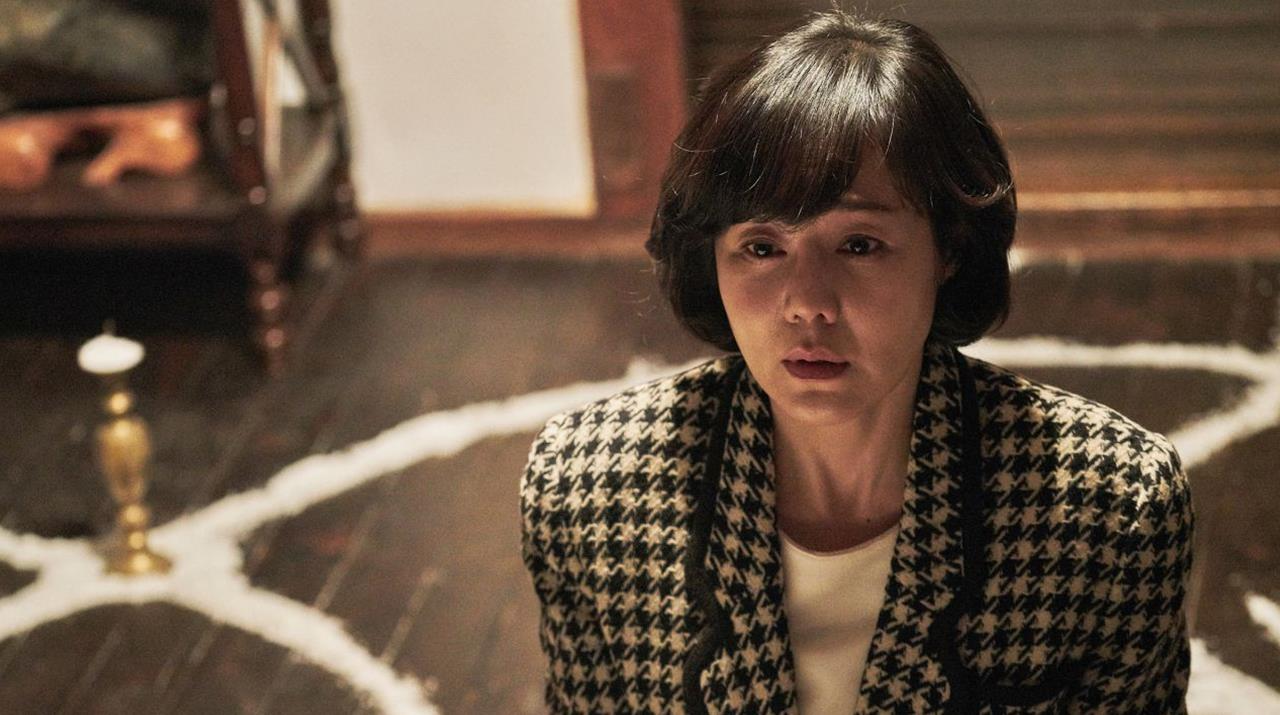

The past is best left alone in Lim Dae-woong’s psychological horror
In 1992, Kang Min-hee (Yunjin Kim) is arrested for the murder of her husband (Jo Jae-yoon) and son (Hyo-je), though her son’s body is nowhere to be found. Min-hee is haunted by several spooky things that happened in the house, such as the appearance of several spectral figures wandering her hall, and insists that these apparitions are the cause of her lost son. She is released 25 years later thanks to a terminal illness, but kept under house arrest. Determined, and helped by local priest Choi (Ok Taec-yeon) she sets out to discover what happened to her son.
A remake of a Venezuelan film, House of the Disappeared isn’t a horror really, but it’s certainly really good at pretending to be one. People pop in and out of the house, doors slam, and mystery arms grab you from the beyond – but House of the Disappeared has a little bit more to it than just ghosts. And it’s a plot development that allows it to transcend its confines and tell a more interesting story on inevitability, fate and letting go of the past.
House of the Disappeared is a pretty strong remake, but suffers by not really doing anything particularly new with the idea. In many places, it’s a shot-for-shot copy, but when the original is this good, it’s hard to really fault the remake. Yunjin Kim is doing a lot of work to sell the concept and the horror, as well as Jo Jae-yoon whose increasingly mad husband character ramps up the drama and sends the story spiralling.
I think the best way to describe this film – and whether or not anyone is likely to get something out of it – is to compare it to one of those really clever, horror-themed Doctor Who episodes. Ones that take an existing concept and trick the audience into thinking it’s actually a real ghost, or zombies. They’re usually the most memorable ones, and for good reason. House of the Disappeared has more going for it than that, but not too much.
Looking at it as its own piece of work: in a way, the film bears several resemblances to Kim Jee-woon’s A Tale of Two Sisters, which similarly dealt with horror tropes entirely within a house, only for the truth of the matter to reveal something else entirely. Disappeared is a lot less grounded in reality of course, but it similarly shows us scenes we’ve seen before, recontextualised with new information. But unlike Two Sisters, it allows us to make these connections a bit earlier, and lets us play along much earlier, allowing for a more interactive experience.
In the end, House of the Disappeared is more clever than it is excellent. It’s well worth watching, don’t get me wrong, but when a film has to juggle its concept, its payoffs and keep things appropriately creepy throughout, it never excels at any one of those aspects. Nevertheless it’s a damn good adaptation, and one that’ll satisfy people looking for a ghost story with a twist.
Verdict: Occasionally hampered by generic horror tropes, House of the Disappeared boasts a good cast, strong themes and an oppressive atmosphere.
House of the Disappeared (2017)
Also known as: 시간위의 집
Korean
Director: Lim Dae-woong
Writer: Jang Jae-hyun
CAST
Yunjin Kim – Kang Mi-hee
Ok Taec-yeon – Priest Choi
Jo Jae-yoon – Chul-joong
Park Sang-hoon – Hyo-je
Go Woo-rim – Ji-won
Hwang Joon-woo – Joon-ho
Kwak Ji-hye – Yeon-hee
Leave a Reply