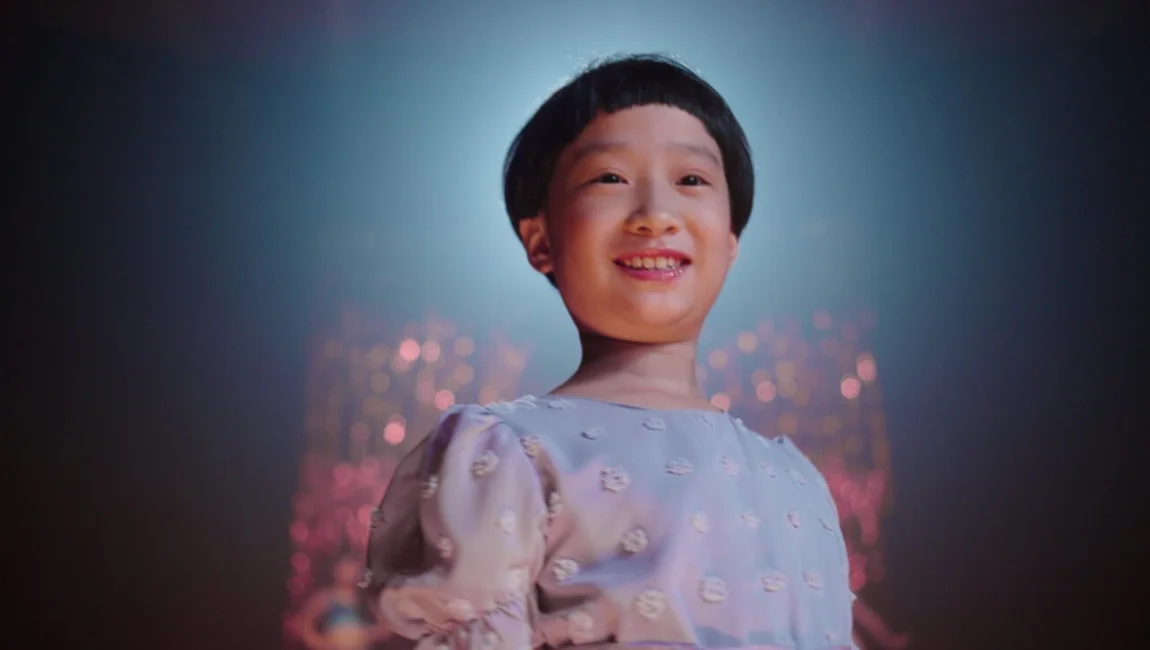

Singapore, 1994. Young Swee Swee (Ong Xuan Jing) finds herself torn between two worlds after her parents divorce. With a mother who seems constantly annoyed at having to look after her, and a father struggling to make ends meet, Swee Swee forges a path of independence by selling contraband chewing gum to her classmates.
I spoke to director Ang Geck Geck Priscilla about the story of Ah Girl, its connections to the real world, and the universal need for independence.

The Asian Cinema Critic
First of all, obviously, congratulations, I really liked the film, I thought it was fantastic. Does [Ah Girl] take any elements from your own childhood?
Ang Geck Geck Priscilla
So this is actually mostly based on my personal story, and I wrote this film 12 years ago.
It must have had quite a long production process.
I started writing this feature film after I was done with my first short film, Broken Crayon, as my final year thesis project for university. I was working on the treatment before that, but officially started the script around 2015.
I didn’t do anything about it until I finished another two short films, because I felt I wasn’t ready to make a feature yet. Finally, in 2017, I found a producer. By 2019, we were going into production, but after waiting two years, my producer faced financial problems and had to drop the project. At the time, I was quite sad because I waited two years, and when he rejected it, it triggered my childhood trauma and abandonment issues.
It was very tough, and I went into a dark hole for a while. When I finally recovered, I told myself I was going to make the script better. I researched similar case studies and spoke to psychiatrists and psychologists about family, children, and divorce cases. In the end, they suggested I see a counsellor. Initially, I was hesitant because in Asia, seeing a counsellor is quite a taboo and people aren’t as open-minded about such things.
Was the film a response to that—a way to get these topics out in the open?
Yeah. Initially, when I wrote the script, I didn’t even know who or what I was writing for, just that I had a strong feeling I wanted to write it. Along the way, I started looking inwards, and it helped resolve those questions. The script grew together with me. Over time, as my maturity and sensibility changed, the script evolved from something very dark into something more hopeful.
Were there consultants you worked with to express that truth, or was it fully your own fabrication?
To be honest, I had a hard time. I saw script consultants, but it didn’t work out because I couldn’t figure out the script or understand the importance of why I wrote it. Sometimes I thought I was writing for my grandma, my father, or my mother, so the main character kept changing.
What I was sure of was that I wanted to tell it from a kid’s perspective. When I was a child, adults shunned me to one side, feeling my voice wasn’t important. I wanted to write this film because there were many things I wanted to tell adults, to let them know I actually understood a lot. Even though adults had things going on, I felt for them and had things to say.
The big question was how to end the film. Was it an ending for each of them, or an ending for myself—me as an adult looking back and giving the younger child what she needed to be heard?
Seeing a counsellor helped me much more than script consultants. Consultants know what works structurally, but because this film was so personal, they found it hard to guide me. Over the years, time changed the way I viewed things. My goal as a filmmaker has always been to use film as a tool to help people feel less alone and empower them. Once I figured myself out, I could write an ending from a distance where audiences could feel their own inner child healing.
Do you feel this film will speak to international audiences, or did you write it for a uniquely local audience?
When writing, I didn’t think too much into that. I just wrote from the deepest part of my heart. As years passed, I realized divorce and growing up in broken families are universal issues, though I didn’t specifically write it for any particular country.
Because I took 12 years, producers often asked what was so special about this simple divorce story. Since it’s character-driven, it was hard for them to envision visually. It was tough, but if I had gone into production in 2019, I wouldn’t have made the film you saw today without that added maturity. Completing it and getting into film festivals is just a bonus to me.
In the film, traditional parental roles feel reversed—the mother provides most of the income while the father stays home, and even the grandmother takes money from the mother. How did you define these parental roles and their impact on Swee Swee’s life?
In the film, the family is struggling financially. The mom complains about being unhappy while having to provide for the grandmother. Because of this, Swee Swee becomes very independent and tries to help by solving the adults’ problems, growing up too fast for her age. She tries to gain love by fixing things, but her family doesn’t understand her needs and instead seeks her attention.
There’s an intergenerational cycle happening where the adults don’t know how to love themselves, which makes them look selfish and stops them from knowing how to properly love their children. They love the kids in their own way, but not in the way the kids actually need.
The parents also seem to seek validation from outside sources or force the child to choose between them.
Yes. When the mother asks who she wants to be with, it puts immense stress on the child. Children shouldn’t have to choose between parents. It reflects that the parents need validation and reassurance—thinking that if the child chooses them, it means they are loved.
Those are decisions a child shouldn’t have to make, especially when she also feels responsible for protecting her younger sister.
Exactly. As a child, she feels very helpless and vulnerable.
I like how she tries to gain independence and control by selling banned gum on the black market. What is the significance of using a banned substance and the broader themes of control?
The Chinese title, Pao Pao Tang Nvhai, translates to Bubblegum Girl. Growing up when Singapore banned bubblegum in 1992, it was always a question mark in my head.
Bubblegum is a metaphor: you chew it, blow a bubble, it bursts, and you can restart again. In life, if we make mistakes, we can always try again and make different choices. It also represents elasticity and resilience. It shows Swee Swee is resilient, willing to go against norms for her family, and strong.
The film is about a girl searching for love and belonging who eventually learns to choose and love herself. We can’t choose our parents, but we can choose how to move forward and what to let go. By choosing herself, she breaks the intergenerational cycle of trauma. The white light at the end of her bus journey represents hope and self-love.
I wish the film great success in theatres and look forward to your next project.
Thank you! I’m currently writing a psychological horror film, which is an extension of my first short film Broken Crayon. I’ve loved horror since I was six years old. Eventually, I also hope to make a trilogy following Swee Swee into her teens and her 40s.
Leave a Reply