
In Philip Yung’s historical crime drama, you always pay the price.
“Fortune or misfortune, neither can be avoided.”
Anyone familiar with HK crime thriller is probably somewhat familiar with the Independent Commission Against Corruption, or ICAC for short. It was formed in the 70s in response to a huge influx in corruption within the Hong Kong police. While accepting small bribes and gifts has always been par for the course (for better or worse), corruption took a major turn in the 50s and 60s when Lam Kong and Liu Lok came on the scene.
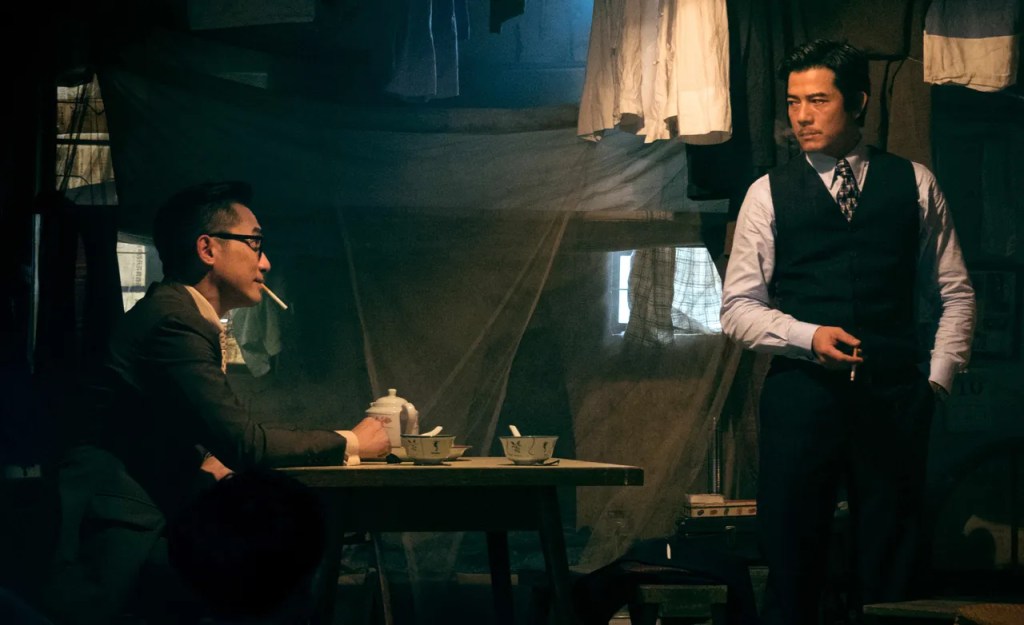
Where the Wind Blows follows the exploits of these two real-life men. Lok (Aaron Kwok) starts his journey wanting to uphold the law, but whose exposure to those small acts of bribery leads him to form a bigger, better and far more destructive corruption ring. Collaborating with Lam he quickly gains trust within the triads and creates a scheme wherein the police and triad effectively stay out of each others’ business. For a fee, of course.
Things quickly begin to escalate, as Lok’s behaviour grows increasingly erratic: he reconnects with a former flame, cheats on his wife (Du Juan) and his visions start to get too large for Lam, putting them both starkly on opposing sides.
Philip Yung’s historical thriller has a lot going on. From its nonlinear storytelling, to its decades-spanning plot, to its ever shifting visual style. It accomplishes a lot, and even in with a rather lengthy runtime feels like it never stalled for too long. Despite having two main characters that take up most of the screen time, Where the Wind Blows needs to expand on its story with complex side characters and historical context. It’s Paul Thomas Anderson by way of De Palma’s Untouchables, with all the directorial expertise that suggests.
Philip Yung goes all out visually, utilising every trick in the cinematic handbook to immerse the audience as much as possible into the seedy world of 1960s Hong Kong and it works gorgeously. He splices real stock footage of the past with filmed portions edited to look exactly like those clips, perfectly placing his characters into the time period without ever looking hacky or fake. The film constantly switches between colour styles, film grain and aspect ratios to enhance the verity of the story and it works an absolute treat. Everything from the seediness of Hong Kong’s vice scene to the brutal hardships of the second world war feels era and stylistically appropriate.
Leung and Kwok are incredible performers who slide into these roles effortlessly. Leung is always effortlessly loveable, whose amiable smile makes him the de facto good guy even when his actions are far from that. Kwok meanwhile has a lot more work to do, but does wonderful work showcasing every side of Lok: from the smooth charmer who tap dances his way into everyone’s hearts to the ruthless kingpin of a cabal of cops. He never goes too far in one direction, and there’s hints of his completely personality throughout, allowing for the character to remain consistent, even during some of his most questionable moments.
Du Juan, meanwhile, completely overshadows the rest of the supporting cast. Initially it seems like Choi Chan, Lok’s wife, will be a passive player and a victim in Lok’s schemes, instead the character has plans of her own, and Du plays the character with as much complexity as is deserved, from sweet to calculating without any major, jarring shifts in personality.
I did mention that the film’s length feels right, considering the story it’s telling. But that said, there are a few scenes – especially near the end – where it seems like the film is getting a touch too preachy, with its praise of the ICAC and the work is does. It’s hard to say if it’s an editorial choice, or something else, but it does drag out a film that, at this point, has gone past two hours and could really do with ending soon.
In all, Where the Wing Blows is an excellent historical thriller with some brilliant editing and a top-notch score. It has the feel, style and complex story one would expect from this vice-laden period of Hong Kong’s history.
Verdict: Part history lesson and part crime drama, Where the Wind Blows is an expertly directed, occasionally messy, but always entertaining slick piece of cinema.
Overall entertainment: 8.5/10
Violence: 5/10
Sex: 3/10
Vice: 9/10
Characters: So many damn characters
Best cameo: Richard Ng shows up!
CGI panther: In a film loaded with excellent visuals, this one was a strange choice
Where the Wind Blows (2022)
Also known as: 風再起時
Cantonese
Director: Philip Yung
Writers: Philip Yung, Effy Sun
 The Asian Cinema Critic
Leave a comment