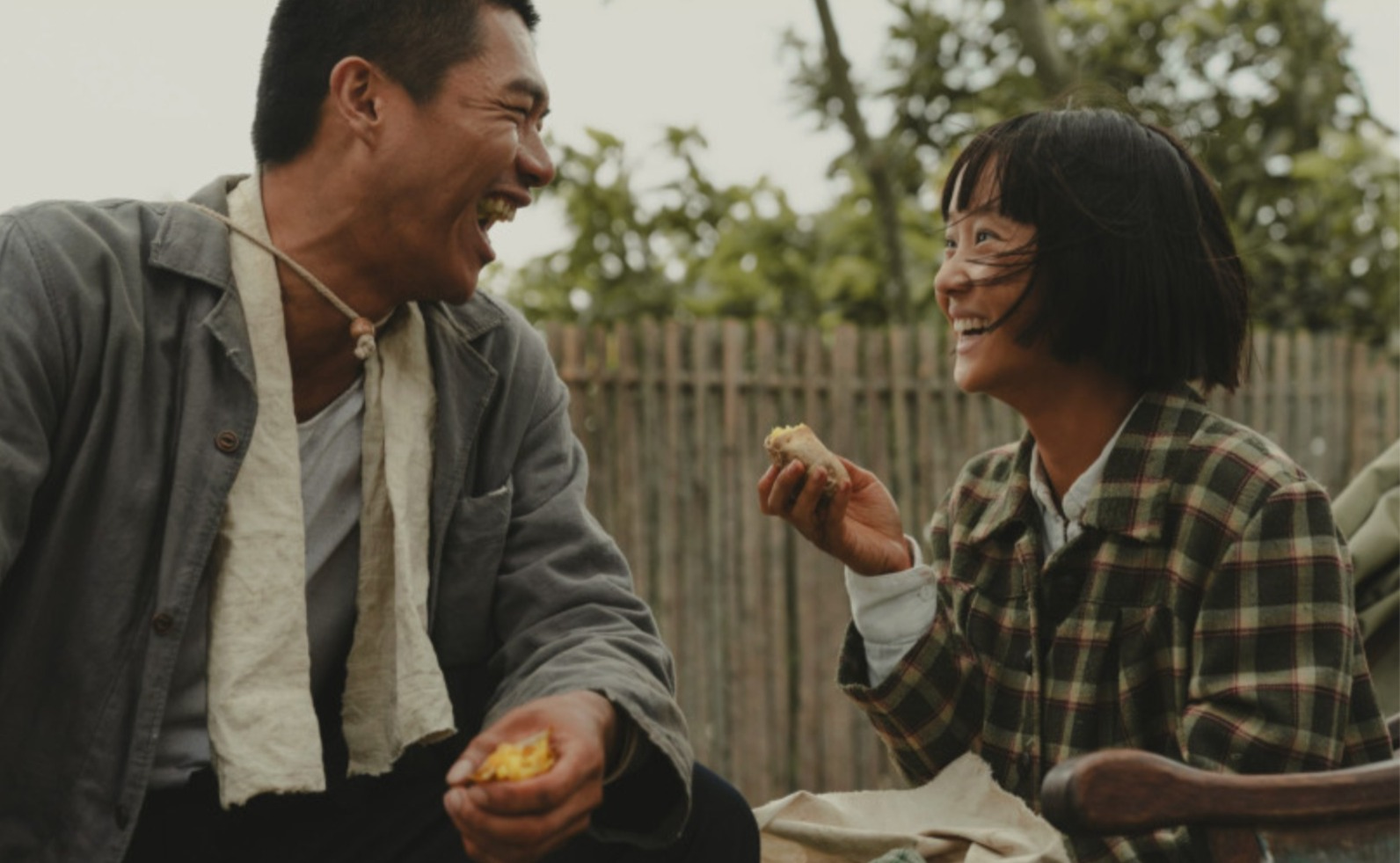
Cycle rickshaw driver Chao Kung‑tao explains the origin of his name: after his father had seven daughters, he finally had a son and cried out, “Thank heavens for giving me justice!” Filmmaker Chen Yu‑hsun once remarked: “The answer [of the film] lies in the protagonist’s name. He is called Chao Kung‑tao (Rendered Justice).”
Chao Kung‑tao is portrayed as a knight‑errant figure, a man who helps the little girl Yue on her journey. In the 1950s, she travels about 250 kilometres from Chiayi to Taipei to retrieve her executed brother’s remains. She carries a watch, a few coins, and two sweet potatoes. One cannot help but ask: how far would one go to collect a family member’s body at great cost, while struggling to survive? Chao says, “Your forty dollars only gave you the nose and the ears. But let’s try.” He almost becomes Yue’s substitute elder brother—less literate, less “correct,” often childlike with a humorous Cantonese accent—while Yue shows bravery and honesty. Their shared frankness and purity create a playful and authentic bond, forming the emotional core of the film.
Yue also encounters singer A‑Xia, a family member residing in Taipei. Now a grown, attractive woman and a successful lead entertainer in a troupe, she is relatively respectable. Seeing her sister on stage, shining like a star and bringing joy to everyone, Yue smiles tearfully, her face reflected in the lights. It is the shock of witnessing feminine beauty and good health for the first time—someone in the family actually thriving and exuding warmth. A rare moment of gratitude is granted.
The film explores morality, kindness, and human weakness. Poverty and fear dominate, yet moral dilemmas permeate the narrative. Adults often compromise due to social position or survival, while Chao resists taking advantage. The icy, high‑ranking official who loves and cares for a child who may not be his own simply because he is in love; Chao, trapped morally, once betrayed his platoon under torture, yet makes conscious choices to bring his comrade’s remains home. Characters are loud, pompous, sneaky, sometimes cowardly—revealing the limits of human endurance. Yet kindness shines through: the policeman who arrested Yue but offered her breakfast; the medical school staff who offered help for free; Chao choosing not to kill the official asleep beside a child. Perhaps an ideal society should be a safe space where kindness and integrity are never forced to be tested.
Water imagery runs throughout: mist, fog, rivers, clouds. At first, the haze seems to symbolise the White Terror, obscuring morality and truth. Yet the metaphor deepens: clouds become rain, nourishing deserts; rivers rise into fog, a liminal state before dispersing. Fog may seem disappointing at first but eventually finds its way ahead. It recalls Lebanese‑American poet Khalil Gibran’s verse:
The river needs to take the risk of entering the ocean,
because only then will fear disappear.
It is not about disappearing into the ocean,
but of becoming the ocean.
The film deliberately avoids strict realism. Its muted palette of greys, pale blues, and earthy tones symbolises a tale of the past. Misty backdrops and diffused light blur edges, reflecting uncertainty under martial law in Taiwan. Characters often appear as silhouettes, embodying obscured truth and suppressed suffering. Yet humour and tenderness soften the sociopolitical tension. Contrary to the usual treatment of this historical theme, the film allows space for kindness and humanity. Laughter coexists with grief. The film is a tragicomedy, but not quite aligned with Chaplin’s famous observation that “life is tragic in close‑up but comic in long‑shot”. Here, it feels reversed: sorrow balanced with humour, hardship with tenderness.
When Chao Kung‑tao repeatedly shouts “Let’s go!”, each cry may signal a permanent farewell. Yet those who leave do not vanish; they remain forever part of the scenery of our lives.
A Foggy Tale (2025)
Director: Chen Yu-hsu
Leave a Reply