A Tokyo sculptor and an architect reconnect in rural Nagi, where quiet routines, distant military echoes, and shared memories intertwine, revealing how art, solitude, and ordinary lives shape human bonding.
Nagi Notes unfolds as a multi‑track narration following a handful of intertwined lives in a small town several hundred kilometres from Tokyo. In Japanese, the title is Nagi Diary, a name that feels more intimate and personal. The film draws inspiration from Oriza Hirata’s play ‘Tokyo Notes’ (1994), where twenty characters drift through a Tokyo art museum while a distant European war rages. But Nagi Notes reverses the scale: the landscape is wider, the cast smaller, and the emotional focus tighter—centred on the connections formed by two women who have left Tokyo behind.
The story begins with Yuri’s arrival in the village, observed by a schoolboy on a bicycle. By the film’s end, that same boy and his special friend reappear, also on a bicycle—this time seen by her—creating a quiet circularity that binds the narrative together.
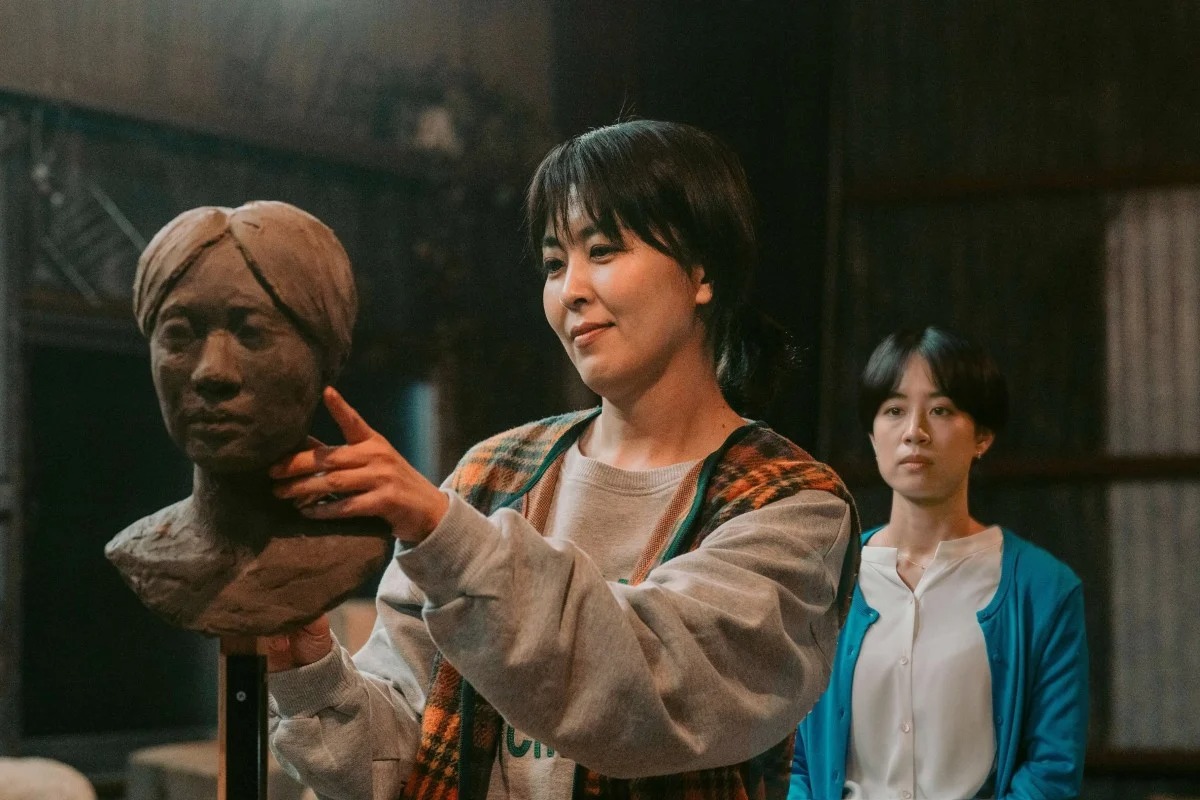
One of the impressions that lingers is the distant artillery rumble cutting across an otherwise peaceful rural life. The film draws a subtle parallel between the shadows of war and daily life, between national upheaval and private solitude. Yoriko, the woman from Tokyo, has moved to Nagi for reasons never fully explained. She works in a small studio carving wooden human figures. When Yuri comes into town to pose for her, their sessions—full of measuring, pausing, remembering—become a space where fragments of past lives drift into the present. Slowly, a relationship renews and deepens between the two women, shaped as much by shared silences as by spoken memories.
When asked whether she feels lonely in such a remote place, Yoriko replies that loneliness exists everywhere. The real town of Nagi is fascinating: one of the towns with the highest fertility rates in Japan, thanks to an active government policy encouraging childbirth through generous family‑support measures. Even more curious is the coexistence of a military base and a famous contemporary art museum—“We have a military, but we also have a beautiful museum,” someone remarks. These contradictions shape the film’s atmosphere. The museum becomes a key site for conversations, just as the studio is. Art channels communication; for instance, Keita’s confession to Haruki takes place inside a small camera‑obscura‑like box.
Yoriko elaborates on her artistic philosophy: she prefers sculptures that can rot, decompose, and scatter, but are always welcoming, like the small roadside Buddhas she admires, rather than monumental architecture that dictates who may enter. This contrast resonates with the film’s backdrop. The film opens with devastating news of the ongoing war in Ukraine, later juxtaposed with Russian musicians performing balalaika at a weekend family event in Nagi. Art and individual lives do not resist national events—they simply exist alongside them. In Nagi, public announcements—whether war updates or death notices—are absorbed into the rhythm of ordinary life.
Yoriko’s creative process is one of constant doing and undoing. She sometimes destroys or defaces her own works mid‑creation, a gesture she links to Samuel Taylor Coleridge’s ‘Person from Porlock’—the idea that interruptions are part of the creative process. Coleridge believed he had perceived the entire course of a poem in a dream, only to be interrupted by a visitor “on business from Porlock”. Yuri’s arrival from Tokyo—though not as a stranger—brings its own kind of interruption to the town, setting small shifts in motion. Yet the film suggests that despite disruptions, what matters is the willingness to look closely, to inspect one’s subject—or one’s life—to its deepest point.

Nagi Notes (2026)
Also known as: ナギダイアリー
Japanese
Director: Koji Fukada
Writers: Oriza Hirata (nvoel), Koji Fukada
CAST
Shizuka Ishibashi – Yuri Sakashita
Takako Matsu – Yoriko Endo
Kenichi Matsuyama – Yoshihiro Iguchi
Kawaguchi Waku – Haruki Iguchi
Kiyora Fujiwara – Keita Higashi
Leave a Reply