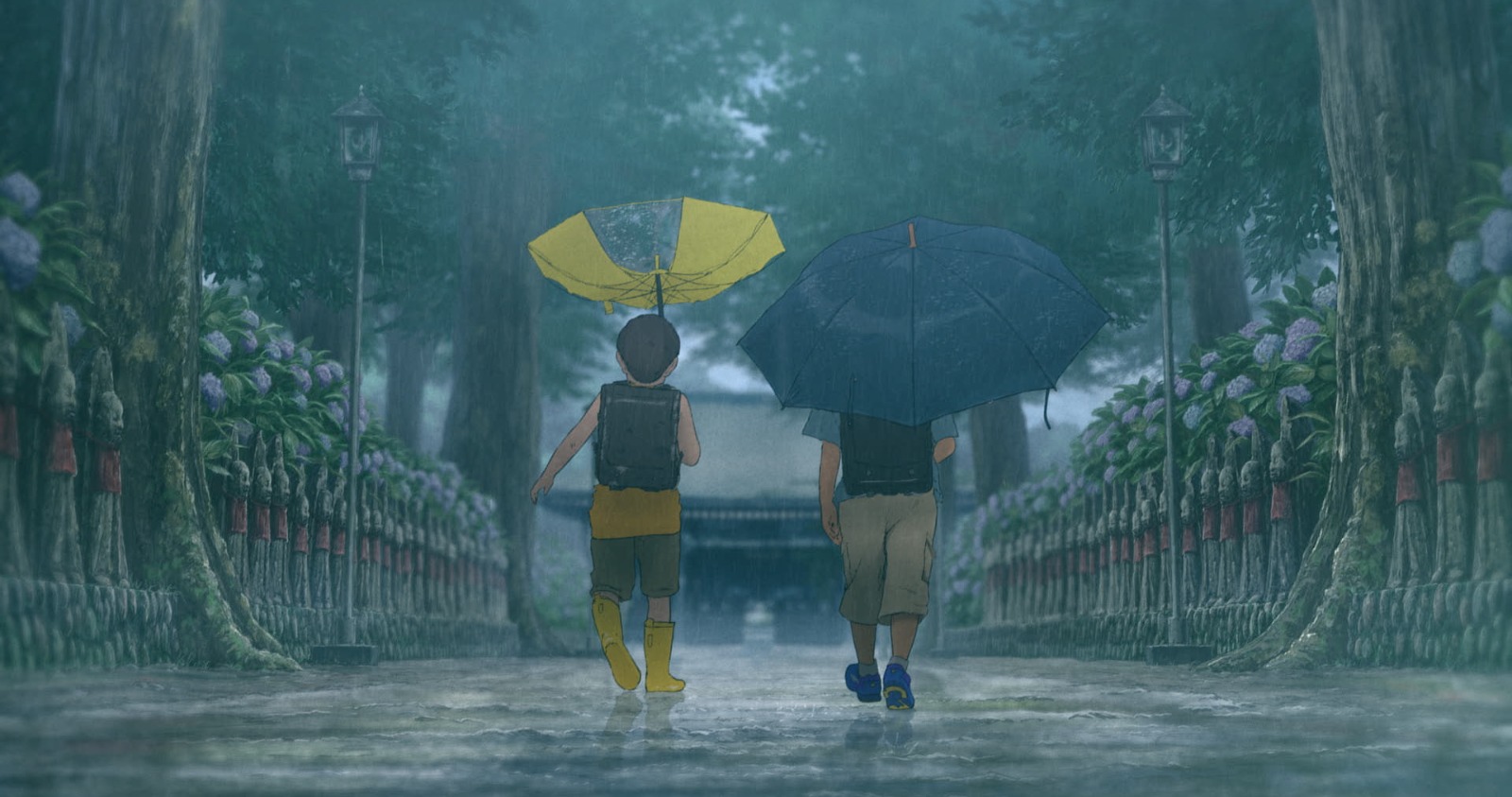

Tsubasa and Kyotaro grow up together, then drift apart, each recalling their shared past differently. Their parallel perspectives reveal misunderstandings, loneliness, and the fragile, alien ways children interpret the world.
We Are Aliens tells two parallel stories of two boys growing up together in school and then slowly growing apart. As Tsubasa says, “One day, I couldn’t talk to him anymore.” The angst—whether hormonal or simply the turbulence of youth—feels like a rehearsal whose consequences only become clear much later. The film’s structure, divided into two versions from each child’s perspective, highlights how differently the same moments can be experienced, how misunderstandings accumulate, and how they can lead to a point of no return. In early adolescence, immature minds can easily misread another person’s emotional state or intentions. Shyness, social awkwardness, or fear of vulnerability all shape the mistakes we make while growing up.
The graphic style, which did not immediately mesmerise me, was not the reason I attended the 08:45 screening at Directors’ Fortnight at the 79th Cannes Film Festival this year. I went out of curiosity—and because I managed to swipe a hard‑to‑get ticket. I had genuinely assumed the film would involve some supernatural elements, but I was pleasantly surprised to find that the “aliens” were metaphorical instead. Some scenes were cinematographically delightful, humorous, and warm. The story is composed of small, seemingly insignificant moments that, in hindsight, can have a lasting impact on a person’s life.

The setback lies in the second perspective—from the “alien” Kyotaro—which impeccably, possibly excessively, justifies his unusual behaviour in a way that turns him into a victim in all aspects of life. I found it difficult to believe he would grow up along this trajectory, even though life does unfold unpredictably. It felt as though, in the narration, something essential was missing between the chapters. Familiar with East Asian cinematic values, I often find the themes of regret and the exaggerated weight placed on youthful days difficult to fully relate to. Toward the end, the sentimentalism and drama felt like an overdose.
Tangentially, I have a theory about this. In many East Asian societies—changing, but still deeply shaped by conformity—one’s identity is expected to be largely solidified by age 25. The tradition of meeting old classmates every year reinforces comparison with one’s high‑school self. It’s as if high school were the peak of life, the defining moment, and any decision made then becomes crucial and irreversible. Nostalgia becomes a safe space for exploring unsaid words and unexpressed feelings within a collectivist culture. Western films often focus on rebellion or self‑expression in youth; East Asian films often focus on reflection and emotional restraint. This thematic pull is understandable, but it permeates the viewing experience. For local audiences, it reinforces a familiar emotional script; for viewers who didn’t grow up in this culture, it can feel a bit alienating.
My favourite part of the film wasn’t the friendship, the falling‑out, or the reunion. It was the sequence in which Kyotaro describes how he sees the world—or the universe—what makes him an “alien.” Those images were graphically rich and full of poetry. I hoped they would lead to a more intriguing development of the characters. But their transition into adulthood felt somewhat arbitrary and unconvincing. I still do not think the intended moral is that children shouldn’t be left alone, although adults in the film appear mostly to reprimand or punish rather than offer tenderness. Still, the boy’s sense of wonder permeates these scenes, reminding us not only of our own childhood but also of how we may live in this world as aliens—strange, observant, and full of imagination.

We Are Aliens (2026)
Also known as: 我々は宇宙人
Japanese
Director: Kohei Kadowaki
Leave a Reply