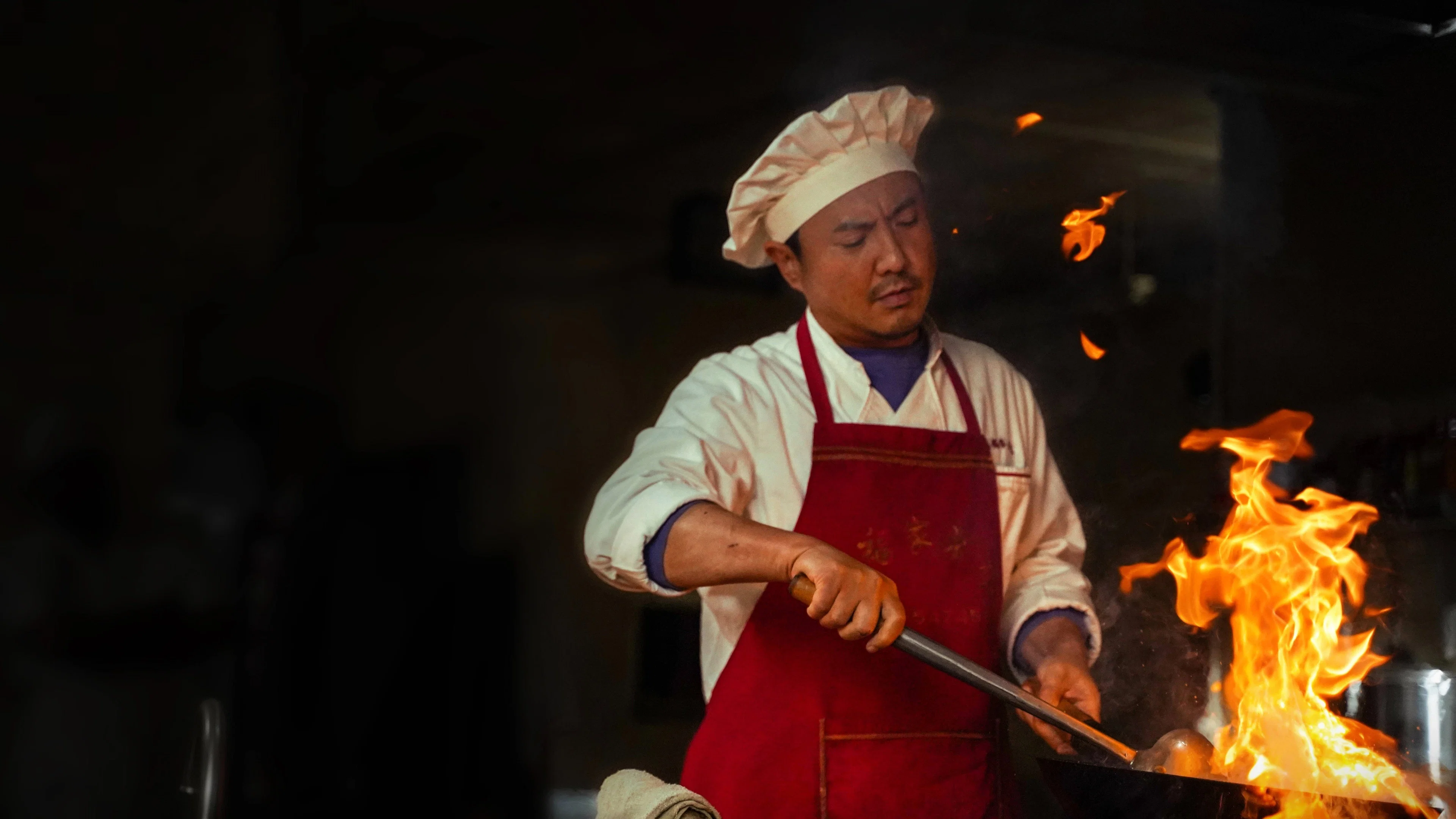
In Wen Muye’s war drama, breaking bread very rarely leads to brokering peace.

You know, I don’t often talk about TV series on this website. It would be a lot to go on about each season and the way they …. hang on. This is a movie? Oh boy. Once Upon a Time in the Middle East is, like its title, unmanageably long and entirely unsure in what it wants to be.
Xu Fu (Shen Teng) is a man who, due to an outstanding debt, accepts a job as head chef in a Chinese restaurant in a made-up Middle Eastern country. The restaurant is a massive success, but things take a dive when the USA invades and starts a war. It’s 2002, and though the location is a fictional country, it’s pretty clear the film is pretending to be Iraq in all but name. Despite this, the restaurant flourishes as a spot for the wealthy to eat, despite the countless tragedies and famines, and Xu even makes use of orphaned children as unpaid waiters, with one even becoming his sous-chef. All very heroic stuff.
And then a bunch of horrors happen, all the while the film is trying to tell us how food can bring people together. The Wikipedia page, that doesn’t remotely read like some people involved in production edited it heavily, aggressively tells us that this is a war film about the lives beyond the soldiers and the fighting. And, yeah … no, it isn’t. It’s briefly about a restaurant trying to make the best of a bad situation, but once Xu Fu and his buddy Ma (Jiang Qiming) get arrested on suspicion of terrorism, it’s just sort of a regular war movie with inexplicably lovingly-rendered scenes of food being prepared.
Once Upon a Time in the Middle East is the most movie, cramming what could have been three seasons of TV into one 140-minute long slog of a film. First, Xu Fu runs a restaurant, and when his boss drives his bomb car into a military base, is arrested. And once he’s about to leave, the not-Taliban shows up to kidnap him and then he has to Schindler’s List a bunch of child soldiers to safety and oh my god this thing is unrelenting. It just keeps going, smashing together feel-good comedy, drama, and scenes from The Hurt Locker without any sense of pacing or what emotional whiplash the audience is suffering. Is this a feel-good film about how a Chinese Saviour transcends war through good? It might be, but it’s hard to tell when every other scene is some Paul Greengrass-esque shit with guns being fired, children blowing themselves up, and starkly real depictions of bugs crawling out of eye sockets.
The film is as long as it is because it’s basically two entirely different films riffle-shuffled together. It loses itself constantly, and characters that are sympathetic in one scene are completely unlikeable in the next. Nuanced takes regarding each side are often drowned out by scenes of brutality. The film is bookended by an older Xu telling customs in this country about the time he was arrested for terrorism, but that story ends about 90 minutes in. It’s crazy that the film just continues into an entirely different plot about the not-Taliban training child soldiers and how one act of food poisoning saves them all.
I really don’t know what to make of this one. It was partially based on real accounts of similar things happening during the US invasion of Iraq, and some reality could have really helped here. It seems a lot like someone wanted to make a starkly real war story about one chef surviving, and then some busybody in the CCP felt the need to chime in and shoehorn a bunch of moments where Chinese culture and cuisine saves the day. It wouldn’t be the first time a good film has been ruined by a need to toe the party line, but it’s rare for it to be this jarring. In the end, Once Upon a Time in the Middle East is torn between its worlds. It’s at war with itself, and ends up achieving none of it particularly well. If it wanted to be a film that spoke to the masses through communist propaganda, it could have been that, and it could have easily been a powerful story about surviving in a war-torn hellscape. But it can’t be either. You can’t have your Scorpion Christmas tree cake and eat it too.
Verdict: The film had good intentions, and more nuance than expected, but it can’t decide what it wants to be, what it wants to say and how it wants to say it.

Once Upon a Time in the Middle East (2026)
Also known as: 欢迎来龙餐馆
Mandarin, Arabic, English
Director: Wen Muye
Writer: Wen Muye
CAST
Shen Teng – Xu Fu
Jiang Qiming – Ma Junsheng
Omar Sherif – Seif
Zhang Xiwei – Xu Le
Wei Qing – Xu’s mother
Sherif Sobhy – Zaid
Yasmine Rahmy – Amina
Karma Hasim – Susu
Naira Al-Qasim – Lina
Ahmed Salim – Ali
Faruk Muhammad – Jamal
Jason Paul Field – Peter
Russell Shealy – Morgan
Aarif Rahman – Tony Wang
Leave a Reply