by Vivien Leung
A Hong Kong bus explosion sparks a tense investigation, uncovering two young lovers driven to radical violence by injustice, repression and despair, while a forensic veteran pieces together their fractured humanity.
We’re Nothing at All is a strange title for what first appears to be a detective film—a noir‑tinged investigation into a double‑decker bus explosion. It opens with a street scene I know by heart as a local. Before I could even blink, the explosion hits: a signature move from Herman Yau. Certain scenes and stylistic choices recall Hong Kong’s B‑films of the 1970s, when censorship was looser and filmmakers were bolder. Oddly enough, the explosion feels refreshing, even cathartic. The aftermath—chaotic and disorienting—evokes the investigative atmosphere of real‑life incidents. It reminded me of watching the evening news with my parents as a child, when crime stories felt immediate and emotionally charged. The images may be low‑resolution, but the feelings are high‑resolution.
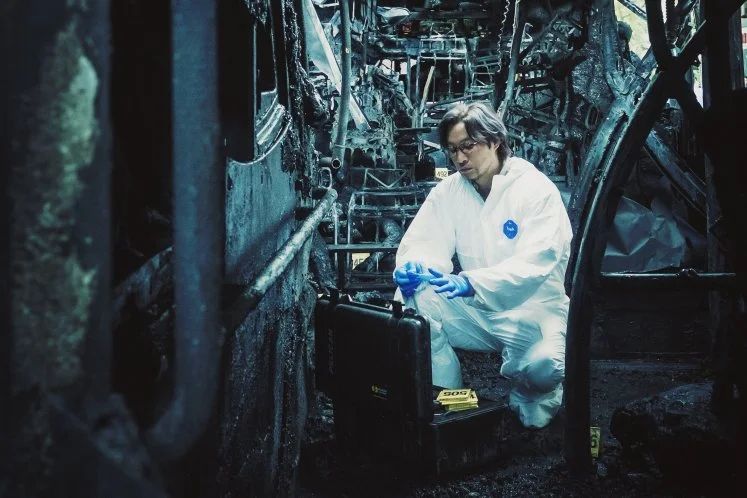
Despite running over two hours, the film is remarkably tight, well balanced and precisely executed. Its parallel chronology—intercutting the investigation led by Lung Sir, the forensic specialist, with the emotional unravelling of the offenders—reveals both technical precision and psychological complexity. With his fluid identity and empathetic intuition, Lung Sir becomes both the technical anchor and the emotional counterpoint to the offenders. The flashbacks and investigative breakthroughs align, though not always seamlessly; the film offers the audience a privileged, almost omniscient point of view. The story is based on a real case in Wuhan back in 1998, yet it feels even more surreal set in Hong Kong. At first, it is hard to fathom such violence erupting on an ordinary commuter bus on a weekday morning on Valentine’s Day.
Herman Yau has, of course, blown up several Hong Kong landmarks on screen before—the Chek Lap Kok airport, the Tsing Ma Bridge, the Cross‑Harbour Tunnel. Through these acts of cinematic vandalism, Yau continues to provoke, reiterating the central theme of his new work: anger can destroy everything. The film builds anger layer by layer: unfair treatment at work, fractures within the family and, and especially the fraught relationship with the dysfunctional father figure, marked by emotional and physical harm. The audience senses where Fai and Ike are heading, but not when the final trigger will be pulled. There is also a strong undercurrent of frustrated desire—intimacy used as transaction, affection withheld or disabled, emotions repressed. The tension mirrors the anger: when release never comes, something else eventually erupts.
At several points, the characters, Fai and Ike, could have stepped back from the brink. Small acts of kindness—a sister’s love, a simple barbecue dinner when one feels welcome—offer fleeting chances for redemption. A lottery win might have stabilised their lives. But these moments either never arrive or come too late. Regret permeates the film. Even if they had not committed the act, another wave of injustice would likely have pushed them over the edge: forced eviction from their subdivided flat, a frightening medical diagnosis, another life sentence and social stigma. Tragedies are only told in retrospect, but why must understanding come only after the damage is done? A line written on Fai’s door reads: “In an avalanche, not one flake is innocent.”

Beyond the “die‑for‑love” motif, smoking becomes another recurring symbol of romanticism—a way to connect, to flirt, to create a private space for reflection. The lighter that ignites the final device also becomes a symbolic switch, a point of no return. The film is carefully structured: dates and numbers appear clearly, including the day smoking was banned in Hong Kong, significant for both smokers and non‑smokers. Another romantic motif is the iconic Vitasoy (soy milk drink in Hong Kong). On the coldest night of February, after a devastating act, a warm bottle of Vitasoy becomes a moment of fragile comfort. The plan is conceived that night, over warmth held in trembling hands. “When I’m in too much pain,” Fai says, “many people will die.”
During the Q&A, Thor Lok (who plays Andrew) noted that the film is deeply geo‑specific: “If you don’t live in Hong Kong, you might only grasp 70 percent of it.” It is not just the physical geography, but the fleeting conversations, the arguments and monologues among strangers and non‑central characters—in other words, the daily struggles of Hongkongers. The audience becomes an eavesdropper on their own ordinary lives, nodding and shaking their heads. I asked Herman Yau whether the film was truly about sexuality. He replied briefly: “It was merely an entry point; the scope is much larger.” The film examines anger—how it forms, how it festers, how it radicalises. When injustice repeats without recourse, there is only one eventual outcome.
Perhaps the title We’re Nothing at All can be read in at least two ways:
We are nobody to anyone—atomised in a restless, indifferent city.
Or: We wish we were nothing at all—stop defining us, stop cornering us, just leave us alone.
After the screening, my friend and I walked along the street where the explosion scene was filmed, and past the convenience store where the characters bought their Vitasoy. We didn’t get the warm drink, but we could almost taste it in the air, mingled with the imagined scent of smoke.

–
We’re Nothing at All (2026)
Also known as: 我們不是什麼
Director: Herman Yau
Writer: Herman Yau
Leave a Reply